Restructuring of arts council structure
How are the preparations progressing?
Appointment of the pool of experts
The Finnish Arts and Culture Agency is accepting nominations for members of the Pool of Experts between 16 March and 24 April 2026. The Council of Arts and Culture will select the members after consulting key stakeholders in the arts and culture.
Nominations will be requested from a wide selection of national and regional actors. In addition to the recipients of the letter, anyone working in the arts can nominate candidates. Anyone can also express their own interest in becoming a member of the pool of experts by submitting an online form.
Based on the nominations, the Finnish Arts and Culture Agency will prepare a proposal for the composition of the pool of experts. The planned size of the pool of experts is 200 to 300 members.
It is hoped that the candidates will represent different age groups, living in different parts of Finland and representing different genders. It is also desirable that the candidates represent all the different sub-genres and professional groups within each field of the arts, as well as the diversity of the arts and culture sector.
The Finnish Arts and Culture Agency will prepare a new peer review model in spring 2026. Key issues include the composition and rotation of the grant assessment panels, as well as various solutions related to the transparency of decision-making, non-discrimination and the presentation of decisions.
The Council of Arts and Culture will confirm the peer review procedures and appoint members to the pool of experts after commencing its operations in July 2026.
Appointment of the Council of Arts and Culture
In January 2026, the Ministry of Education and Culture sent a request to key arts and culture communities to nominate candidates for the Council of Arts and Culture for the period 1 July 2026 – 30 June 2029. The Government will appoint the Chair and other members of the Council of Arts and Culture for a term of three years at a time. In addition to the Chair, the Council of Arts and Culture will have at least eight and at most twelve members. In addition, a maximum of seven deputy members will be appointed.
The members and deputy members of the Council will represent expertise in arts and cultural policy from a wide range of perspectives. For example, the members of the Council may represent expertise in the making, production and dissemination of art, the strategic development of the arts and culture sector, arts and culture research, production structures and business in the arts and culture sector, and sustainability issues in the arts and culture.
The Ministry of Education and Culture hopes that regional and linguistic perspectives, as well as expertise related to minority cultures and cultural accessibility, will also be taken into account when nominating candidates.
What will change?
The restructuring is part of the Education and Culture Administration 2030 reform project, within which the Arts Promotion Centre Finland (Taike) and the National Audiovisual Institute (KAVI) merged as of 1 January 2026 to form the new Finnish Arts and Culture Agency. The current arts councils will continue during the transition period until 30 June 2026.
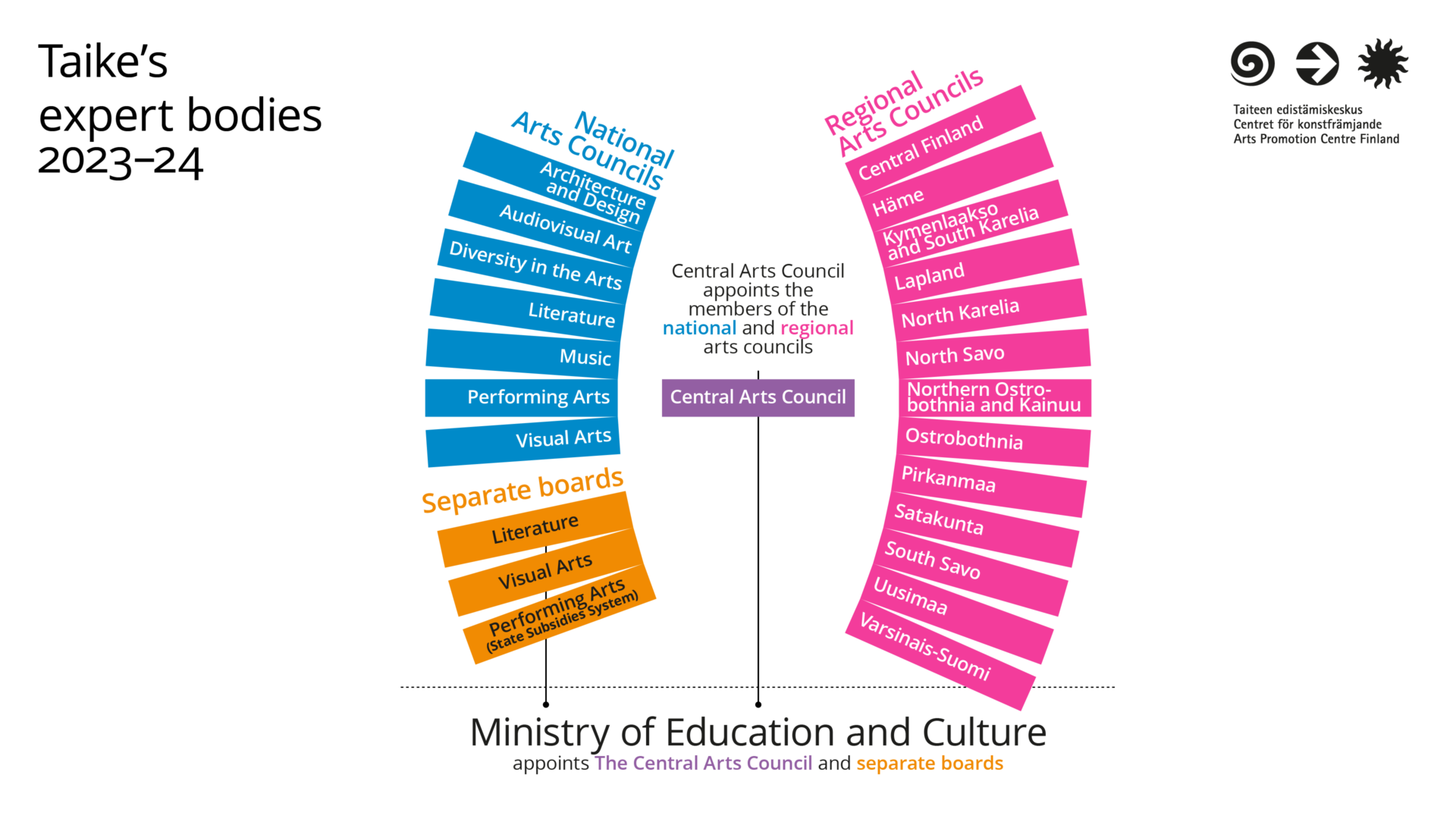
Current structure
- Taike currently comprises 24 expert bodies that decide on the awarding of grants and prizes, as well as provide expert opinions.
- The national arts councils decide on the awarding of grants and prizes to artists and artist groups within specific artforms.
- The regional arts councils decide on the awarding of grants and prizes to artists and artist groups within their regions.
- The Central Arts Council appoints the members of the national and regional arts councils.
- The Central Arts Council is appointed by the Ministry of Education and Culture.
- Taike also has three boards based on separate legislation. The restructuring will not affect the operations of these boards.
New structure
- The current national and regional arts councils will cease to exist.
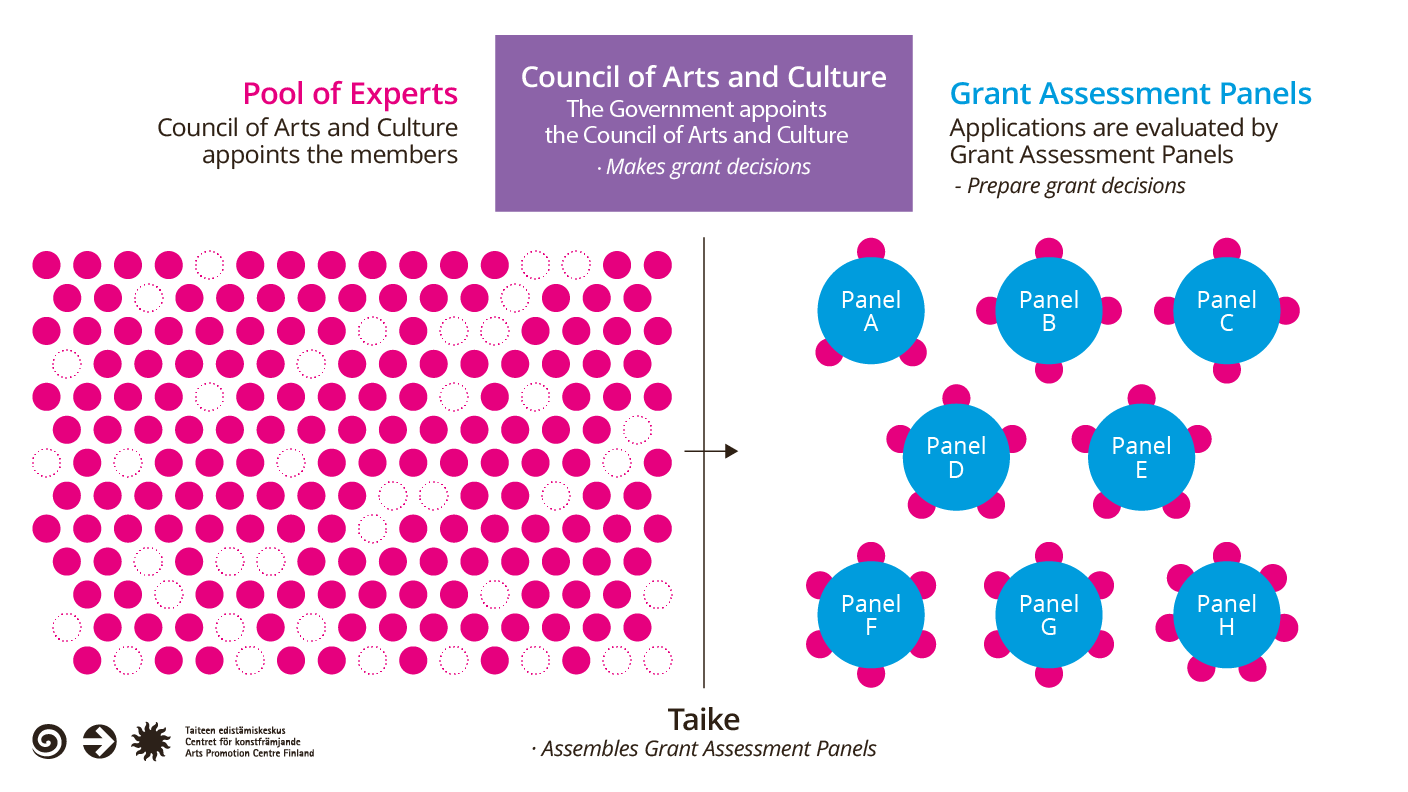
- The new Finnish Arts and Culture Agency will have a Council of Arts and Culture, a pool of experts and grant assessment panels, the composition of which will change regularly.
- The preparation of decisions based on peer reviews will be carried out within grant assessment panels that comprise members of the pool of experts. The panels will be appointed by the Finnish Arts and Culture Agency.
- The Council of Arts and Culture will make all grant decisions based on peer reviews as prepared by the grant assessment panels.
- The Council of Arts and Culture will appoint the members of the pool of experts.
- The Government will appoint the Council of Arts and Culture
What will remain the same?
The aim of the legislative preparations for the new system has been to ensure the principles of peer reviews and the autonomy of the arts. The processing of grant applications will continue to be based on the assessment work of experts representing the arts sector.
The new law still requires the implementation of regional equality. This is one of the criteria used to compile the pool of experts. With the elimination of regional arts councils, the new agency must have other means to ensure a balanced distribution of funding across Finland. The geographical distribution of resources will be closely monitored when the new system comes into force.
The reform does not apply to grant decisions for communities. Government grants for communities will continue to be civil servant decisions, and assessment panels may be used in their preparation.
The discontinuation of the regional arts councils will not affect the operations of the Finnish Arts and Culture Agency’s regional offices.
Why the restructuring?
The restructuring will dismantle the system of arts councils that has existed since 1968 of separate national arts councils and regional arts councils. The current arts council structure has been in place since 2013. The restructuring is in response to, among other things, the increased workload of the arts councils, challenges related to conflicts of interest, and the uneven distribution of work.
The new system brings flexibility to assessments. Grant assessment panels can be assembled taking into account the number of applications. Grant assessment panels appointed for each round of applications make it possible to create more diverse assessment groups, in which the specific characteristics of different forms of support and artforms can be taken into account more broadly.
The restructuring also provides more flexibility for peer reviewers, who can influence when and how many applications they assess. They can also, if necessary, apply for a grant while they are members of the pool of experts, as long as they disqualify themselves from the grant assessment panels for the application round in question.
How are the preparations progressing?
Taike has begun preparations for the new peer review model. Key issues include the size and appointment of the pool of experts, the composition and terms of the grant assessment panels, and various solutions related to the transparency of decision-making, equality, and presentation of decisions.
Taike is organising stakeholder meetings and interviews as part of the preparations.
The aim of the preparations is to have the new peer review structure outlined by the end of 2025. The appointment round for members to the pool of experts will begin in spring 2026. Proposals will be widely solicited from various parties in the same way as previously for the arts councils.
Government will appoint the Council of Arts and Culture, which will begin operations on 1 July 2026. The Council of Arts and Culture will strengthen the procedures for peer reviews and appoint the members of the pool of experts.
How will the changes be visible to customers?
From the beginning of 2026, the Finnish Arts and Culture Agency name will appear in connection with grant application forms, grant decisions and communications. Grants will also be paid under the new agency's name. Calls for applications for government grants for 2026 will open in autumn 2025 under the name of the Finnish Arts and Culture Agency on the Applyforgrants.fi service.
Changes related to assessments and decision-making will not be otherwise directly visible to customers. Currently, the list of names of council members is known in advance for their entire term. In the new structure, applicants will not necessarily know the names of all the experts working on the grant assessment panel during the application phase. There may be changes to the forms of support, budgets, application deadlines and processing times in the future, but they are not directly based on the restructuring of the arts council structure.
Preparations so far
The need to restructure the arts councils was raised in the external evaluation of Taike (Agency Taking Shape) published in 2021.
Preparations for the restructuring began within the Ministry of Education and Culture in autumn 2023. The draft legislation was presented for public consultation in December 2024.
Changes were made to the draft legislation based on the opinions submitted during the public consultation. Concerns were raised about the autonomy of the arts, peer reviews and regional equality. These were also key issues from Taike’s perspective, and Taike considers the changes made based on the opinions to be important.
The government proposal was submitted to Parliament in April 2025 as part of the Education and Culture Administration 2030 reform project. The government proposal was approved by Parliament on 18 June 2025.
Further information:
Henri Terho, Director of Arts and Culture Funding, [email protected], t. +358 295 249 006